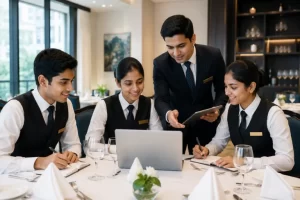
 Students exploring hotel management courses often realise the gap only when they step into a real hotel environment for the first time. They spend years studying hotel operations, food service theory, and culinary management inside classrooms. Then, in their first job, they discover something troubling. They have never handled a real guest complaint. They have never managed live restaurant pressure. They have never coordinated with a housekeeping team. They have never worked through the pace of an actual hotel shift. In hospitality, confidence comes from repeated exposure to real hotel environments. It does not come from textbooks alone. This is why students today value hotel management courses that build operational readiness before college ends, not after it.
This change is occurring within the framework of the continuing expansion of the global hospitality and tourism economy. The industry accounts for more than 10% of global GDP, according to the World Travel & Tourism Council. It deploys hundreds of millions of people worldwide. The hospitality pipeline is expanding across the hotels, travel, food, and customer experience segments. That is why the employers are more interested in the candidates who have already acquainted themselves with the workplace and service standards before graduating. This has led to a huge demand for academics with practical exposure in hotel management courses.
Drawing on insights from Taran Singh, an edtech expert and Sri Chinmay Deodhar Awardee who has guided more than a thousand students through higher education and career decisions, here are some hospitality platforms building stronger industry readiness. They do this through practical learning and continuous operational exposure.
1. Emversity
Most hospitality students spend years preparing for hotel operations before they ever step inside one. Emversity flips this model. It makes the hotel environment itself the classroom. It works with Medhavi Skills University to deliver long-term industry immersion and international exposure within the university’s Diploma and B.Voc programs in hospitality.
Within the B.Voc program, Emversity helps students get placed in real hotels with paid internships. This happens after just six months of foundational training. From there, students continue learning inside live hospitality environments for up to 30 months. They build familiarity with guest relations, front office systems, housekeeping operations, food production, luxury service standards, and customer experience management. They do this while still working toward their qualifications. The platform partners with hospitality leaders including Indian Hotels Company Limited (IHCL), Radisson Hotel Group, Lemon Tree Hotels, and Marriott International. This creates exposure spanning Indian luxury hotels as well as international hospitality settings.
In the Diploma programs, students also gain overseas training exposure. This happens through a partnership with PRISM Hotels.
Many job oriented courses offer limited industry exposure. It usually comes much later in the program. Emversity takes a different path. It builds hospitality education around continuous operational learning from day one. The outcome is a more immersive form of skill based education. Students graduate with more than qualifications alone. This has turned Emversity’s program into one of the more closely watched hotel management courses in the industry today. Students also carry real hotel experience, workplace familiarity, and customer-facing confidence into their first role.
2. Indian School of Hospitality
The Indian School of Hospitality runs a globally influenced hospitality teaching model. For students exploring hotel management courses, its biggest differentiator is clear. The curriculum is delivered in alliance with Les Roches Switzerland alongside Gurugram University. This combines international hospitality exposure with a university-led learning environment.
Over four years, students study hospitality operations, service management, communication, and hotel administration. From Semester 5 onward, students can choose to specialise out of options that include Digital Marketing Strategies, Entrepreneurship, Financial Performance Management, or Service Management. The final year is reserved for an internship phase. This strengthens student familiarity with the workplace. Compared with many hotel management courses across the country, ISH’s teaching model places more weight on academic progression, managerial specialisation, and a global hospitality outlook.
3. Nitte Institute of Hospitality Services
NIHS follows a teaching model that blends structured classroom learning with practical lab training. It also offers guided exposure to operational work. The program combines a university-based learning environment with hands-on exposure to hospitality operations across multiple labs.
The B.Sc. (Hons) Hospitality Management program covers front office management, food production, housekeeping, food and beverage service, communication, and hospitality enterprise administration. The infrastructure includes training kitchens, bakery and confectionery labs, mock guest rooms, F&B training restaurants, and language labs. Students gain practical exposure through workshops, internships, and industrial visits. This is one reason NIHS continues to attract students comparing hotel management courses across the country.
Many hotel management courses focus on accelerated operational immersion. Nitte’s model works differently. It favours gradual professional development within a broader academic setting. For students comparing job oriented courses in hospitality, the institute offers a balanced mix of academics, guided training, and foundational industry readiness.
The Future of Hotel Management Courses
Hospitality education is no longer judged only by campus infrastructure or degree titles. Increasingly, what sets programs apart is timing. It comes down to how early students begin to understand live service environments, customer expectations, and operational pressure. This matters well before they enter a workforce that keeps expanding. The World Travel & Tourism Council reports that travel and tourism grew more than 4% in 2025. This was ahead of global economic growth of around 2.8%.
This growth is pushing hotel management courses to become more immersive and experience-led in how they teach. Models like the one Emversity has built with industry-skilling partners mirror how the hospitality industry actually works today. Hospitality hiring is becoming more experience-driven. Because of this, students are showing stronger interest in practical job oriented courses that can help them move into careers faster and with greater confidence.