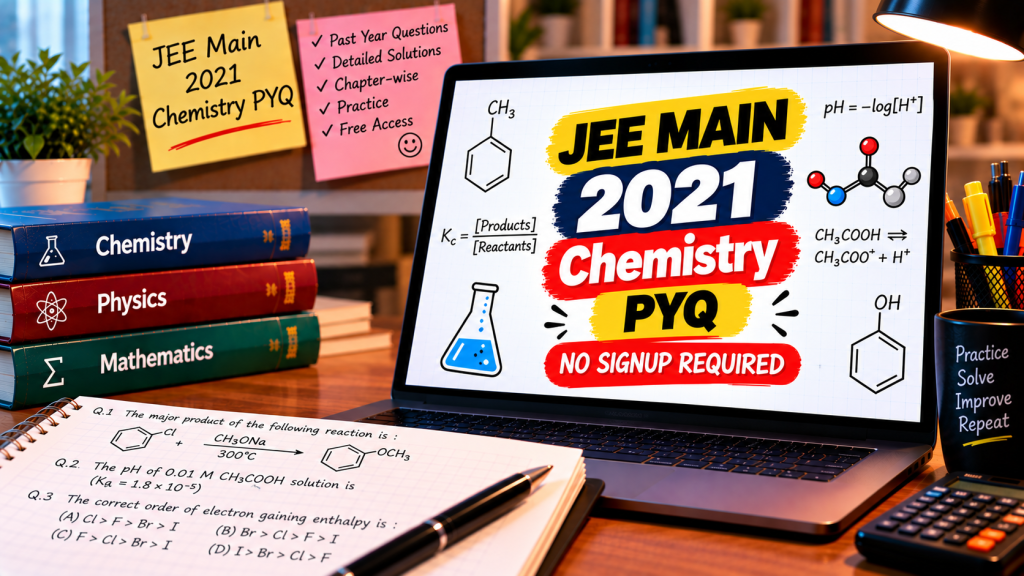
Chemistry in 2021 followed a pattern the other two subjects rarely managed: a near-even split of questions across Physical, Organic, and Inorganic Chemistry, in a year when NTA ran the exam four separate times, in February, March, July, and August. Of the 9,39,008 candidates who appeared across all four sessions, 44 finished with a perfect 100 percentile. Most Chemistry questions that year traced directly back to NCERT lines, with numericals staying simple enough to solve with a straightforward formula rather than a multi-step derivation.
That kind of predictability is exactly why the JEE Main PYQs from 2021 are worth building into your revision now; they show you precisely how evenly NTA distributed questions across the three branches that year. Below, you’ll find a chapter-by-chapter breakdown of the 2021 Chemistry paper, the topics that mattered most, and free chapter-wise JEE Main PYQs for Chemistry to start practicing with.
| Table of Content |
| 1. JEE Main 2021 Chemistry Paper Analysis |
| 2. JEE Main 2021 Chemistry Chapter-wise Weightage & Important Topics |
| 3. Download Free JEE Main Chemistry PYQs 2021 Chapter-Wise |
| 4. What Students Said About JEE Main 2021 Chemistry Paper |
| 5. How to Use JEE Main 2021 Chemistry PYQs for Maximum Score |
| 6. Final Thoughts on JEE Main 2021 Chemistry PYQs |
1. JEE Main 2021 Chemistry Paper Analysis
Easy to moderate summed up Chemistry’s difficulty across 2021’s four sessions, and for once, that rating held steady from February all the way through August. Most questions were pulled directly from NCERT text, with only a handful requiring genuine problem-solving beyond recognizing a fact or applying a standard formula. Physical Chemistry contributed its usual share of numericals, but these stayed simple enough that a clear grasp of the underlying concept was generally enough to solve them quickly.
Difficulty Level at a Glance
| Parameter | Analysis |
| Overall Difficulty | Easy to Moderate |
| Calculation Level | Low to Moderate |
| Conceptual Depth | Moderate |
| Time Required | Low to Moderate |
What stood out most across the year wasn’t any single tricky chapter, it was how evenly the paper distributed its questions across Physical, Organic, and Inorganic Chemistry, rather than leaning heavily on one branch the way some other years have.
2. JEE Main 2021 Chemistry Chapter-wise Weightage & Important Topics
A three-way split defined 2021’s Chemistry paper more than any single chapter did. Based on shift-wise analysis across all four sessions, here’s where the weightage concentrated:
| Chapter | Trend in JEE Main 2021 | Priority |
| General Organic Chemistry & Reaction Mechanisms | Highest weightage | ⭐⭐⭐⭐⭐ |
| Coordination Compounds & Chemical Bonding | High | ⭐⭐⭐⭐ |
| p-Block, d- and f-Block Elements | High | ⭐⭐⭐⭐ |
| Chemical Thermodynamics & Equilibrium | High | ⭐⭐⭐⭐ |
| Atomic Structure | Moderate | ⭐⭐⭐ |
| Electrochemistry | Moderate | ⭐⭐⭐ |
| Solid State & Solutions | Moderate | ⭐⭐⭐ |
| Aldehydes, Ketones & Carboxylic Acids | Moderate | ⭐⭐⭐ |
| Biomolecules & Polymers | Low to Moderate | ⭐⭐ |
| Environmental Chemistry | Low | ⭐⭐ |
Organic Chemistry, particularly reaction mechanisms and General Organic Chemistry concepts like stability of intermediates and acidity-basicity comparisons, carried the heaviest weightage across shifts. Inorganic Chemistry stayed close behind, dominated by Coordination Compounds and periodic trends across the p-, d-, and f-blocks, while Physical Chemistry’s Thermodynamics and Equilibrium chapters showed up reliably enough to be treated as core topics rather than occasional ones.
Did any chapters get skipped?
Not really. Biomolecules, Polymers, and Environmental Chemistry appeared less often than the bigger chapters, but they weren’t left out of the paper. Since these are short, fact-based chapters once revised, treating them as low-effort, high-return topics made more sense than skipping them outright.
3. Download Free JEE Main Chemistry PYQs 2021 Chapter-Wise
Straight to it: free, chapter-wise JEE Main chemistry PYQs from the 2021 papers, ready to practice right now.
| Chapters | Free PYQs |
| Chemical Thermodynamics | Click here |
| Chemical & Ionic Equilibrium | Click here |
| Solid State & Solutions | Click here |
| p-Block Elements | Click here |
| d- and f-Block Elements | Click here |
| Aldehydes, Ketones & Carboxylic Acids | Click here |
| Alcohols , Phenols & Ethers | Click here |
| Chemical Kinetics | Click here |
| Classification Of Elements & Periodicity In Properties | Click here |
| Carbohydrates, Amino Acids, Polymers | Click here |
| Compounds containing nitrogen | Click here |
| General Principals & Process Of Isolution Of Element | Click here |
| Haloalkanes &Haloarenes | Click here |
| Hydrocarbon | Click here |
| Organic Chemistry – Basic Principles And Techniques | Click here |
| Solutions | Click here |
| Some Basic Concepts Of Chemistry | Click here |
| Structure Of Atoms | Click here |
| The S-Block | Click here |
Grab the JEE Mains previous year questions pdf download above to practice offline and check your answers against detailed explanations. Everything is sorted chapter-wise, so you can revise weak areas without wading through an entire paper.
4. What Students Said About JEE Main 2021 Chemistry Paper
Talk to anyone who sat for Chemistry in 2021, and NCERT comes up almost immediately. Feedback across all four sessions described the paper as approachable for students who’d revised the textbook closely, with questions rarely straying far from familiar territory.
Some common observations:
- Organic Chemistry, especially reaction mechanisms, carried the highest weightage across sessions.
- Coordination Compounds and periodic trends were reliable, recurring topics in Inorganic Chemistry.
- Physical Chemistry numericals stayed formula-based rather than multi-step or convoluted.
- Questions were spread fairly evenly across the three branches rather than favoring one heavily.
- NCERT-direct questions made up a large share of the paper across all four sessions.
The clearest takeaway for future aspirants: working through enough JEE Mains previous year questions shows you exactly which NCERT lines and reaction types keep resurfacing, which does more for your score than any amount of extra reference material.
5. How to Use JEE Main 2021 Chemistry PYQs for Maximum Score
Effective preparation of JEE Mains Chemistry starts with treating NCERT as the primary resource, not a supplement to something else. Match your approach to your timeline:
- 6 months or more: Complete every chapter, analyze every mistake, and revise the exact NCERT lines behind each question before moving to the next set.
- 2 to 3 months: Prioritize Organic Chemistry, Coordination Compounds, Chemical Bonding, and Thermodynamics before revising lower-weightage chapters.
- Within 30 days: Solve chapter-wise PYQs under timed conditions. Focus on accuracy on theory-based questions and revisit the related NCERT lines behind every mistake immediately.
6. Final Thoughts on JEE Main PYQs 2021 Chemistry
The JEE Main 2021 Chemistry paper rewarded students who trusted the textbook over shortcuts, with a fairly even spread of questions across all three branches meaning no single chapter could be safely ignored. Practicing these JEE Main PYQs, chapter by chapter, is one of the most reliable ways to build the kind of broad, NCERT-grounded familiarity this section consistently rewards.
Use the free chapter-wise links above to practice regularly, strengthen any weaker chapters, and make Chemistry the section you can count on in your next JEE Main attempt.