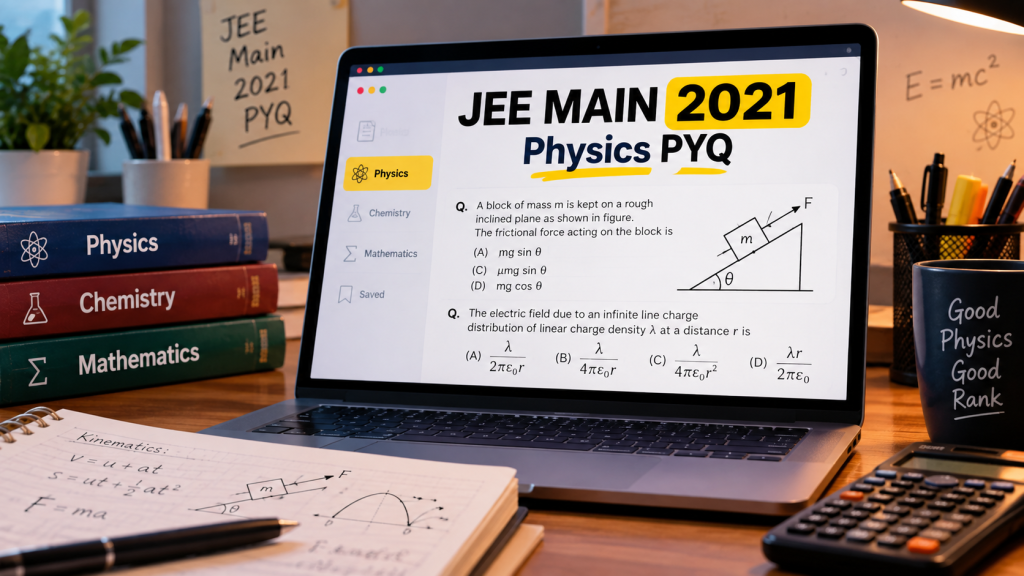
JEE Main 2021 introduced a format tweak that mattered a lot for how Physics got tested: instead of the usual fixed set of questions, each subject now carried 30 questions, 20 MCQs plus 10 numerical-type, with only 25 to attempt and some built-in choice for the first time. That extra flexibility landed at an unusual moment for the exam itself, spread across four separate sessions in February, March, July, and August, with 9,39,008 candidates appearing in total and 44 walking away with a perfect 100 percentile.
Physics itself settled into a fairly dependable rhythm through most of those sessions, built around familiar chapters like Current Electricity, Mechanics, and Waves, with fewer surprises than a shift-by-shift breakdown might suggest. That kind of built-in choice is exactly why the JEE Main PYQs from 2021 are worth revisiting, they show you how NTA used the extra room in the paper. Below, you’ll find a chapter-by-chapter breakdown of the 2021 Physics paper, the topics that mattered most, and free chapter-wise JEE Main physics PYQs to start practicing with.
| Table of Content |
| 1. JEE Main 2021 Physics Paper Analysis |
| 2. JEE Main 2021 Physics Chapter-wise Weightage & Important Topics |
| 3. Download Free JEE Main Physics PYQs 2021 Chapter-Wise |
| 4. What Students Said About JEE Main 2021 Physics Paper |
| 5. How to Use JEE Main 2021 Physics PYQs for Maximum Score |
| 6. Final Thoughts on JEE Main 2021 Physics PYQs |
1. JEE Main 2021 Physics Paper Analysis
Physics settled into a fairly consistent pattern across 2021’s four sessions: moderate difficulty, formula-based questions, and a syllabus split that stayed close to even between Class 11 and Class 12 topics, with Class 12 carrying a slightly bigger share. The February and March sessions were both described as moderate overall, with no unexpected twists in how questions were framed. A typical shift pulled a solid chunk of its questions from Mechanics, several more from Electromagnetism and Current Electricity, and a smaller, steady share from Optics, rounding out with a couple of questions on Units and Dimensions.
Difficulty Level at a Glance
| Parameter | Analysis |
| Overall Difficulty | Moderate |
| Calculation Level | Moderate |
| Conceptual Depth | Moderate |
| Time Required | Moderate |
The pattern held steady across all four sessions rather than swinging wildly from one to the next, which meant a student who’d built genuine familiarity with the core chapters early in the year could walk into any later session without needing to relearn how the paper behaved.
2. JEE Main 2021 Physics Chapter-wise Weightage & Important Topics
Certain chapters showed up so consistently across 2021’s sessions that skipping them wasn’t really an option. Based on shift-wise analysis across all four sessions, here’s where the weightage concentrated:
| Chapter | Trend in JEE Main 2021 | Priority |
| Mechanics (Laws of Motion, Work, Energy & Power) | Highest weightage | ⭐⭐⭐⭐⭐ |
| Current Electricity | Highest weightage | ⭐⭐⭐⭐⭐ |
| Heat & Thermodynamics | High | ⭐⭐⭐⭐ |
| Rotational Motion & Center of Mass | High | ⭐⭐⭐⭐ |
| Magnetism & AC Circuits | Moderate | ⭐⭐⭐ |
| Waves | Moderate | ⭐⭐⭐ |
| Ray & Wave Optics | Moderate | ⭐⭐⭐ |
| Electrostatics | Moderate | ⭐⭐⭐ |
| Modern Physics | Low to Moderate | ⭐⭐ |
| Units, Dimensions & Measurement | Low | ⭐⭐ |
Current Electricity and Mechanics together anchored a large share of the questions across nearly every shift, with Heat & Thermodynamics and Rotational Motion following close behind as chapters students found consistently important, even if not always comfortable. Class 11 topics carried a marginally smaller share of the paper than Class 12 topics, but the gap was narrow enough that neither half of the syllabus was safe to deprioritize.
Did any chapters get skipped?
Not entirely. Modern Physics and Units & Dimensions appeared less frequently than the bigger chapters, contributing a smaller, steadier trickle of questions rather than a heavy share. None of them disappeared from the paper outright, which is exactly the kind of detail these JEE Main PYQs surface once you’ve worked through enough shifts, so a light, formula-focused pass through these chapters was still worth the time.
3. Download Free JEE Main Physics PYQs 2021 Chapter-Wise
Time to get to what actually matters: free, chapter-wise physics PYQ JEE Mains questions from the 2021 papers, ready to practice right now.
| Chapters | Free PYQs |
| Units, Dimensions & Measurement | Click here |
| Laws of Motion | Click here |
| Work, Energy & Power | Click here |
| Rotational Motion & Center of Mass | Click here |
| Heat & Thermodynamics | Click here |
| Waves | Click here |
| Electrostatics | Click here |
| Current Electricity | Click here |
| Ray Optics | Click here |
| Wave Optics | Click here |
| Modern Physics | Click here |
| EMI And AC | Click here |
| Gravitation | Click here |
| Mechanical Properties Of Solids & Fluids | Click here |
| Mechanics | Click here |
| Momentum and Impulse | Click here |
| Motion | Click here |
| Moving Charges &Magnetism | Click here |
| Semiconductors | Clikc here |
| SMH | Click here |
Grab the JEE Mains previous year questions pdf download above to practice offline and check every answer step by step. Everything is sorted chapter-wise, so you can go straight to the topic you want to strengthen instead of working through a full paper.
4. What Students Said About JEE Main 2021 Physics Paper
Ask a student who sat for any of 2021’s four Physics papers, and a similar answer usually comes back: manageable, formula-driven, and rarely a section where time ran out unexpectedly. Feedback across shifts pointed to Mechanics and Current Electricity as the chapters students leaned on most for quick, confident marks, while a handful of Modern Physics and Optics questions occasionally slowed things down.
Some common observations:
- Mechanics and Current Electricity consistently contributed the largest share of questions.
- Heat & Thermodynamics and Rotational Motion appeared reliably across all four sessions.
- Numerical-type questions stayed close to standard formulas rather than testing unfamiliar setups.
- Class 12 topics held a slightly larger share of the paper than Class 11 topics throughout the year.
- The overall difficulty stayed steady session to session, without any one sitting standing out as noticeably harder.
The clearest takeaway for future aspirants: working through enough JEE Mains previous year questions shows you exactly which formulas and setups keep recurring, so you’re not relearning the paper’s habits each time you sit for a fresh attempt.
5. How to Use JEE Main 2021 Physics PYQs for Maximum Score
If your goal is to genuinely prepare for JEE Physics rather than just skim through formulas, previous year papers work best with a plan that matches your timeline:
- 6 months or more: Complete every chapter, analyze every mistake, and revise the related concept before moving to the next set of PYQs.
- 2 to 3 months: Prioritize Mechanics, Current Electricity, Heat & Thermodynamics, and Rotational Motion before revising the remaining chapters.
- Within 30 days: Attempt chapter-wise PYQs under timed conditions, and focus on locking in speed on formula-based questions rather than attempting more of them.
6. Final Thoughts on JEE Main PYQs 2021 Physics
The JEE Main 2021 Physics paper rewarded consistency more than cleverness, students who’d built genuine comfort with Mechanics, Current Electricity, and Thermodynamics moved through session after session without being caught off guard. Practicing these JEE Main PYQs, chapter by chapter, is one of the most reliable ways to build that same comfort before your own attempt.
Use the free chapter-wise links above to practice consistently, strengthen your weaker chapters, and walk into your next JEE Main exam already familiar with how this section tends to behave.