
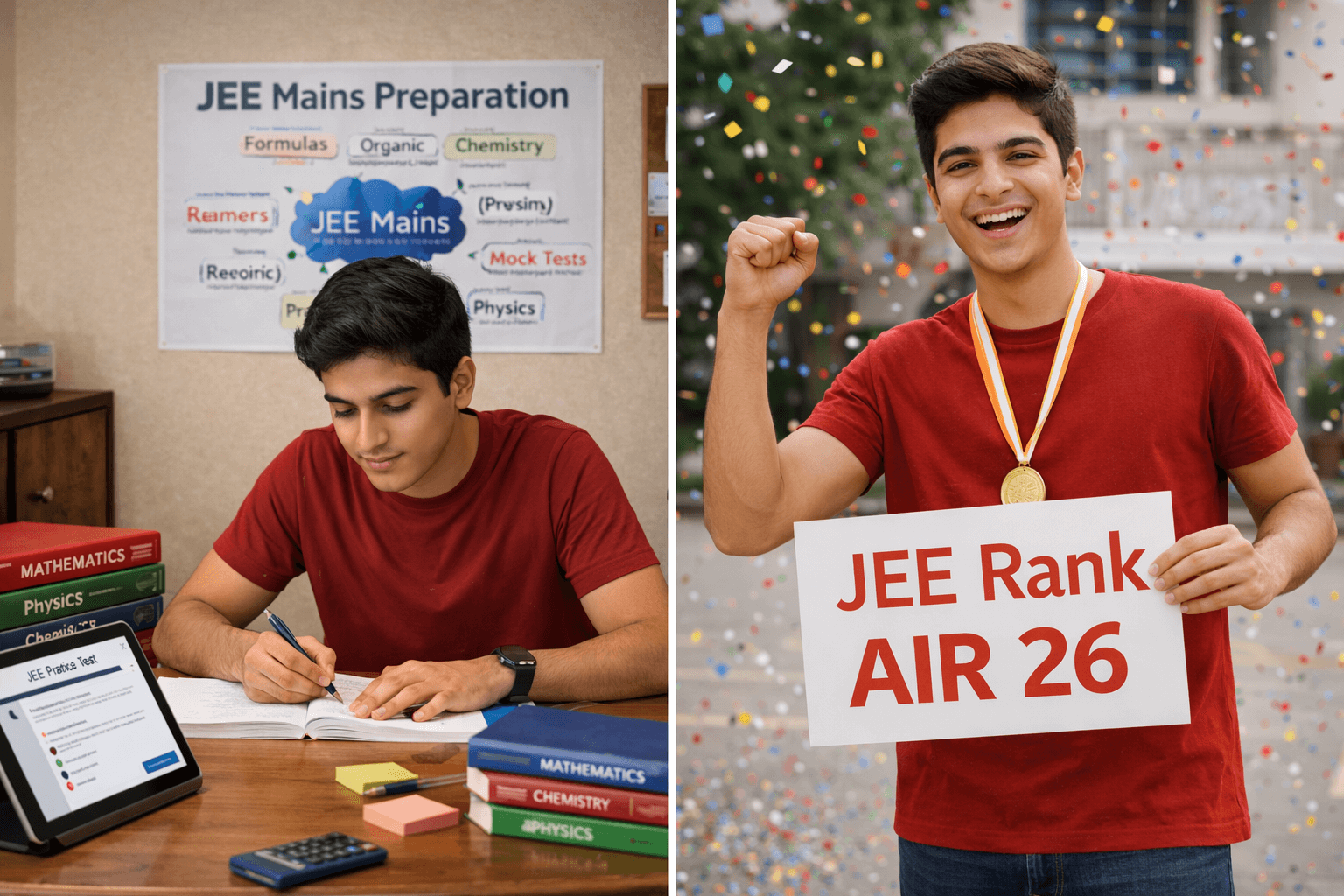
Understanding how to prep for JEE has changed as the exam has become more analytical and time-limited. Success now depends on picking the right questions and managing time well. Many students complete the syllabus but fail to optimise attempts, directly affecting the rank of JEE Mains.
This has pushed aspirants toward data-driven preparation. Platforms that identify scoring gaps, track improvement, and align practice with exam trends are now preferred over traditional routines. Drawing on insights from IIT toppers over the past five years, these apps show how students are preparing more effectively for JEE Mains 2026.
1. Melvano
Melvano is an adaptive JEE preparation platform built to convert focused practice into rank improvement. Many aspirants wonder how to prep for JEE once the syllabus is complete. The real challenge is not learning concepts, but knowing which practice directly improves the rank of JEE Mains.
Melvano cuts out the confusion. Practice is built around questions that actually appear in the exam, with instant feedback after every attempt. The question bank, created by top IIT rankers, concentrates on PYQs, numericals, and mixed-concept problems that make a real difference to scores. Melvano’s AI-based Supermode analyses speed, accuracy, and mistakes across large user data sets and assigns only high-impact questions. This process cuts down practice time by 43%.
Melvano’s deep analytics help students understand exactly where they stand. They can compare average time per question with peers nationwide, track dynamic percentile rankings that update continuously, see what percentage of students made errors on a question, and access real-time All India Rank predictions. Recognised with the IIT Madras Innovative Project Award and winner of the Hednxt Startup Competition, Melvano is free to use with optional advanced tools for serious aspirants.
2. Swayam Prabha
Swayam Prabha is a government-supported learning platform built around NCERT concepts. Clear fundamentals is the first step for how to prep for JEE. Many students lack access to structured teaching. Swayam Prabha tackles this by streaming free classes all day on DTH television. The sessions are taught by professors from IITs, NITs, and IISERs. They explain Physics, Chemistry, and Mathematics using simple logic and solved problems.
Since it runs on TV, it does not need fast internet and reaches students everywhere. With a 4.1-star rating, it is mainly used to revise basics and strengthen fundamentals. Compared to exam-focused JEE apps, Swayam Prabha does not include practice drills, mock tests, or progress tracking. It functions best as a concept-building resource alongside dedicated exam-preparation platforms.
3. NTA Abhyas
NTA Abhyas is the official JEE Main mock test app. It focuses on exam practice, not teaching. After finishing the syllabus of JEE Mains, many students still struggle with how to prep for JEE to get ready for real exam pressure. Solving questions alone is not enough. NTA Abhyas fixes this by offering full-length CBT tests that feel like the actual JEE Main paper.
Each test comes with a simple performance report. Students can see subject-wise marks, accuracy, and time spent in each section. It helps students spot weak spots and fix timing issues. The app is available in English and Hindi and lets users attempt tests offline. With a 3.6-star rating, it is known for a realistic exam feel. It is best used just before the actual exam, not for learning concepts or regular practice.
4. DIKSHA
DIKSHA is an official NCERT learning app supported by the government. Its focus is clear syllabus coverage. The first challenge in how to prep for JEE is completing the syllabus of JEE Mains without gaps. DIKSHA makes this easier. It offers NCERT textbooks, short concept videos, worked examples, and quizzes for Physics, Chemistry, and Mathematics. This builds a strong base before students shift to exam-level practice.
The app is free to use. It works in over 30 Indian languages and allows offline access to most content. With a 4.1-star rating, DIKSHA is widely trusted for clear concepts and syllabus accuracy. Compared to exam-oriented apps, it does not offer mock tests, timed practice, or performance analytics. It is best suited for theory learning, not rank-focused preparation.
5. NCERT e-Pathshala
NCERT e-Pathshala is NCERT’s official learning platform for accurate syllabus coverage. How to prep for JEE starts with fully understanding the JEE Main syllabus. Many students worry about missing NCERT-based topics. NCERT e-Pathshala solves this by offering complete, unchanged NCERT textbooks and study material created under the Ministry of Education.
The app covers Classes 1 to 12 and allows offline access to chapters, supporting consistent revision. With a 3.5-star rating, it is widely used to ensure every NCERT concept is covered. Unlike exam-focused JEE apps, e-Pathshala does not include mock tests, timed questions, or performance analytics. Students mostly use it to complete the syllabus and revise concepts. For test practice and exam strategy, they usually move to dedicated JEE preparation platforms.
How To Prep for JEE: Choose What Actually Improves the Rank of JEE Mains
How to prep for JEE in 2026 comes down to one outcome: measurable improvement in the rank of JEE Mains. Across all the options, Melvano stands out for students who care about rank outcomes. Its daily practice stays tightly linked to how scores improve in real JEE competition.
Swayam Prabha and DIKSHA, on the other hand, work best for covering NCERT basics and strengthening core concepts. NCERT e-Pathshala works well for syllabus accuracy and revision. NTA Abhyas serves as the official benchmark for exam readiness. However, when the goal is rank movement rather than content coverage, students benefit most from a platform that keeps preparation tightly connected to results, not just completion.